19+3
AI agents + humansA 19-agent AI marketing team
Claude + MCP agents connected to Search Console, GTM, Semrush and ad data, automating reporting, audits and research.
- ~15
- Person-agency output
I build AI marketing agents and bots on a 19-agent Claude and MCP stack, with a person approving anything that spends or publishes. I run that stack with three people for reporting, audits and research. Agentic workflows, custom GPTs and n8n-style automation are scoped on the automation page when that is the job.
In 30 seconds
Vicky Lalwani is an AI agent developer for marketing teams. His own stack is 19 agents and 3 people on Claude and MCP, connected to Search Console, GA4, Google Tag Manager and ad data. Customer facing bots are built on the AI chatbot page. Agentic workflows, custom GPTs and n8n-style automation are on the AI automation page. A person approves anything that spends or publishes.
An AI agent developer builds a system that finishes a multi step job: pull the numbers, check the rules, draft the output, and wait for a person.
I run 19 of those agents with three people, on Claude and MCP, for reporting, audits and research. That is the production stack, not a slide.
Customer facing bots are on the AI chatbot page. Agentic workflows, custom GPTs and n8n-style automation are on the AI automation page. Claude setup is on the Claude consultant page, and the longer note is Claude for marketing teams.
Agents handle the work that eats your week: pulling data, checking it against rules, writing the first draft and flagging what needs a human. Your team spends its time on strategy and creative instead.
Every agent I build has a clear job, a defined data source, written instructions and a human checkpoint. No black boxes.
Bot building is part of the same practice, with a different job. A chatbot answers, qualifies and books on your site or on WhatsApp. An automation moves work between Claude, ChatGPT, MCP and the tools you already use, including n8n-style flows and custom GPTs. Anything that spends or publishes still waits.
An agent that sends mail or changes an ad account without a checkpoint is a liability. This is how the options differ.
| This consultancy | An automation agency | A team using ChatGPT ad hoc | |
|---|---|---|---|
| Who builds it | The person who runs the same stack daily | A delivery team you may not meet | Whoever has a spare afternoon |
| Human approval | Required before anything reaches a customer or an ad account | Depends on the statement of work | Usually none |
| Data | MCP connections to the tools you already use | Often a new platform to rent | Copy-paste |
| Handover | Documented so your team can run it | Retainer to keep the lights on | Lives in one person's chat history |
| Bots and workflows | Chatbots and automation scoped as their own builds | Often folded into a larger programme | A prompt saved in one person's chat |
| Best for | Lean in-house teams and agencies in AU, UK or US | Large programmes with many stakeholders | One-off drafts |
Identify the tasks worth automating, with hours saved per month.
Clear role, inputs, rules and human approval points for each agent.
MCP servers and APIs for Search Console, GA4, Ads, Semrush, CRM and Sheets.
Agents tested on your real data until outputs are reliable.
Looker Studio and alerting so you see what agents did and found.
Documentation and training so your team can run and extend them.
Audit the week and pick the highest-value tasks.
Design and build the first agents on your data.
Run in parallel with your team until outputs match.
Add agents and connect them into pipelines.
What working together looks like before you sign anything.
Ad accounts, analytics, data, content and assets stay in your name, always, including if we stop working together.
No minimum ad spend. I'll tell you honestly what your budget can achieve on the free call.
Three months gives the work time to show results. After that it's month to month.
I lead the strategy and I am your contact. A small team handles delivery. My AI agents cover the repetitive audits and reports.
$25 to $50 an hour in USD, with fixed-price audits and monthly retainers on the pricing page. You get a written scope and exact quote after the free 30-minute call.
Regular reports tied to leads, bookings and revenue, not vanity metrics.
Client names and domains withheld for confidentiality.
Claude + MCP agents connected to Search Console, GTM, Semrush and ad data, automating reporting, audits and research.
Rebuilt the patient-acquisition funnel with paid search, AI booking and lifecycle automation.
An AI agent developer designs and ships systems that complete a multi step marketing job on your data. I build them on Claude and MCP, with a written job, a data source and a person who approves the output. The 19-agent stack I run with three people is the working example.
Yes. On this page the job is the marketing agent: audits, reports, search terms, research. The wider build, including custom GPTs and n8n-style flows that move work between tools, is scoped on AI automation. A person still approves anything that spends or sends.
Someone who wires a workflow so it can take the next step, and who writes the stop rule. I do that for marketing teams. The agent fetches, checks and drafts. It does not email a customer, change a bid, or publish a page until a person says so.
Yes. A typical first agent is a weekly report or a search term review. A full stack is built in phases. Your team keeps the accounts. I document the job so you can run it after handover.
MCP (Model Context Protocol) is how Claude reads the tools you already use: Search Console, GA4, Google Tag Manager, ad accounts, Semrush. I connect them with the least access that does the job, read only unless you have approved a change. Setup detail is on the Claude consultant page.
Yes. You work with me, for teams in Australia, the UK, the US and the UAE. Agent builds are quoted per project after the free 30 minute call, and ad hoc work is $25 to $50 an hour in USD. Customer facing bots are a separate scope on AI chatbots.
Agentic AI is a system that can take the next step itself: fetch the report, apply the rule, draft the action, and stop where you told it to stop. It is not a longer chat reply. If you want that pattern for ops, custom GPTs or n8n-style flows, start at AI automation.
A chatbot talks to a customer on your site or on WhatsApp: it answers, qualifies and books, then hands over. An agent works inside your team's tools: audits, search terms, reports. Both need a person for anything sensitive. Chatbots are scoped on the AI chatbot page.
Reporting, SEO audits, keyword and competitor research, content briefs and QC, PPC search term reviews, anomaly alerts and outreach drafts. Strategy, budgets and final approvals stay with people.
Mostly Claude (including Claude Code and MCP) for analysis and long-form work, and ChatGPT where it fits a team's existing tools. I choose per task.
A focused agent such as a weekly PPC report usually takes one to two weeks to build and validate. A full multi-agent stack is built in phases over a few months.
No. They remove repetitive work so a small team can deliver far more. My own stack is 19 agents and three people.
Yes. The same agent can run across every client account, which is where a small agency gets its hours back. A person still approves anything that reaches a client or changes an ad account.
Yes. The work is remote, with afternoon overlap for AEST and AEDT. Perth calls are booked on AWST. See Australia.
A person does. Agents draft, flag and file. They do not email customers or change bids unless someone has approved that step.
A free AI marketing call, a free AI team guide and flexible terms.
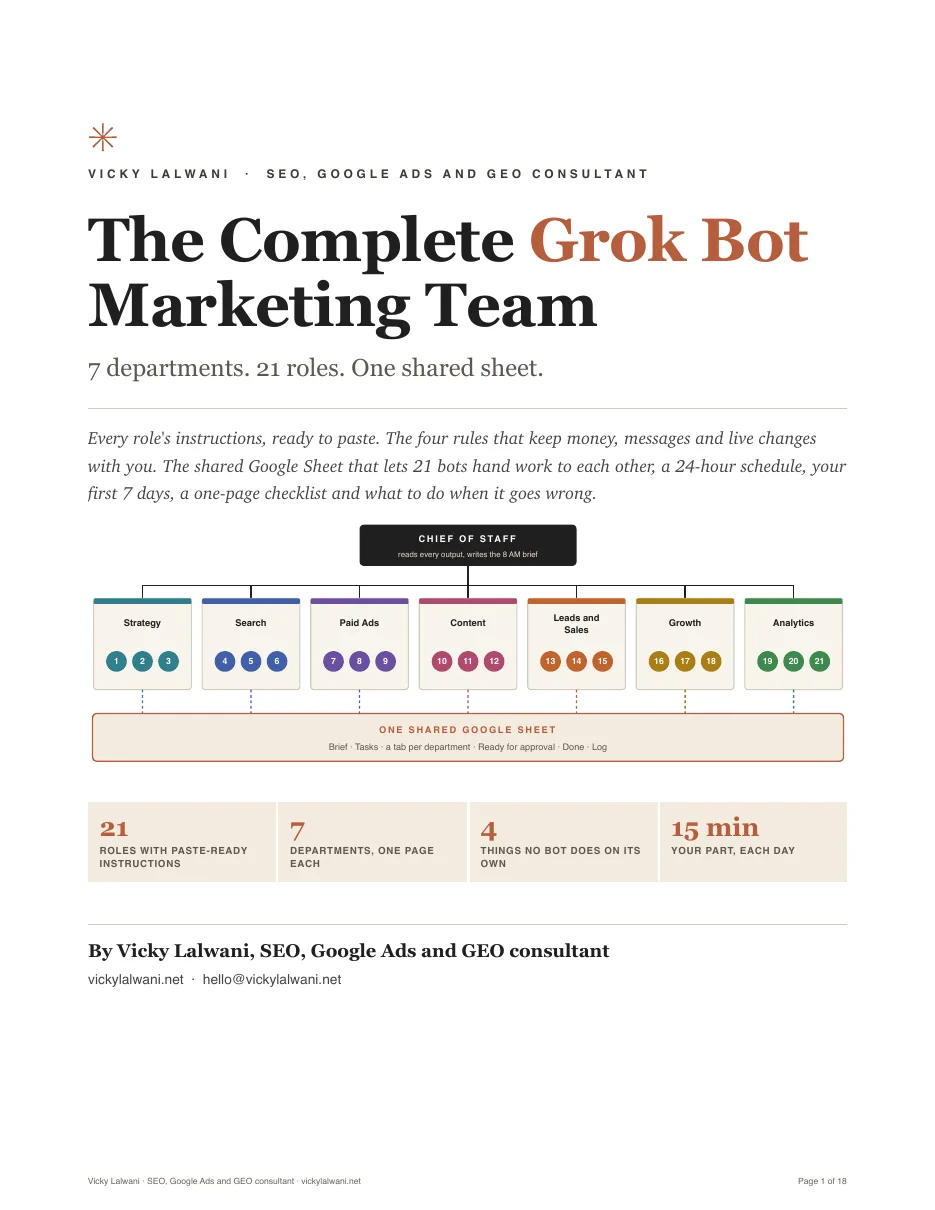
A setup guide for a 21 role Grok Bot marketing team across 7 departments. It covers the four rules no bot breaks, the chief-of-staff bot, paste-ready instructions for every role, the shared Google Sheet that lets bots claim and hand off work, a 24-hour schedule, your first 7 days, a checklist and fixes.
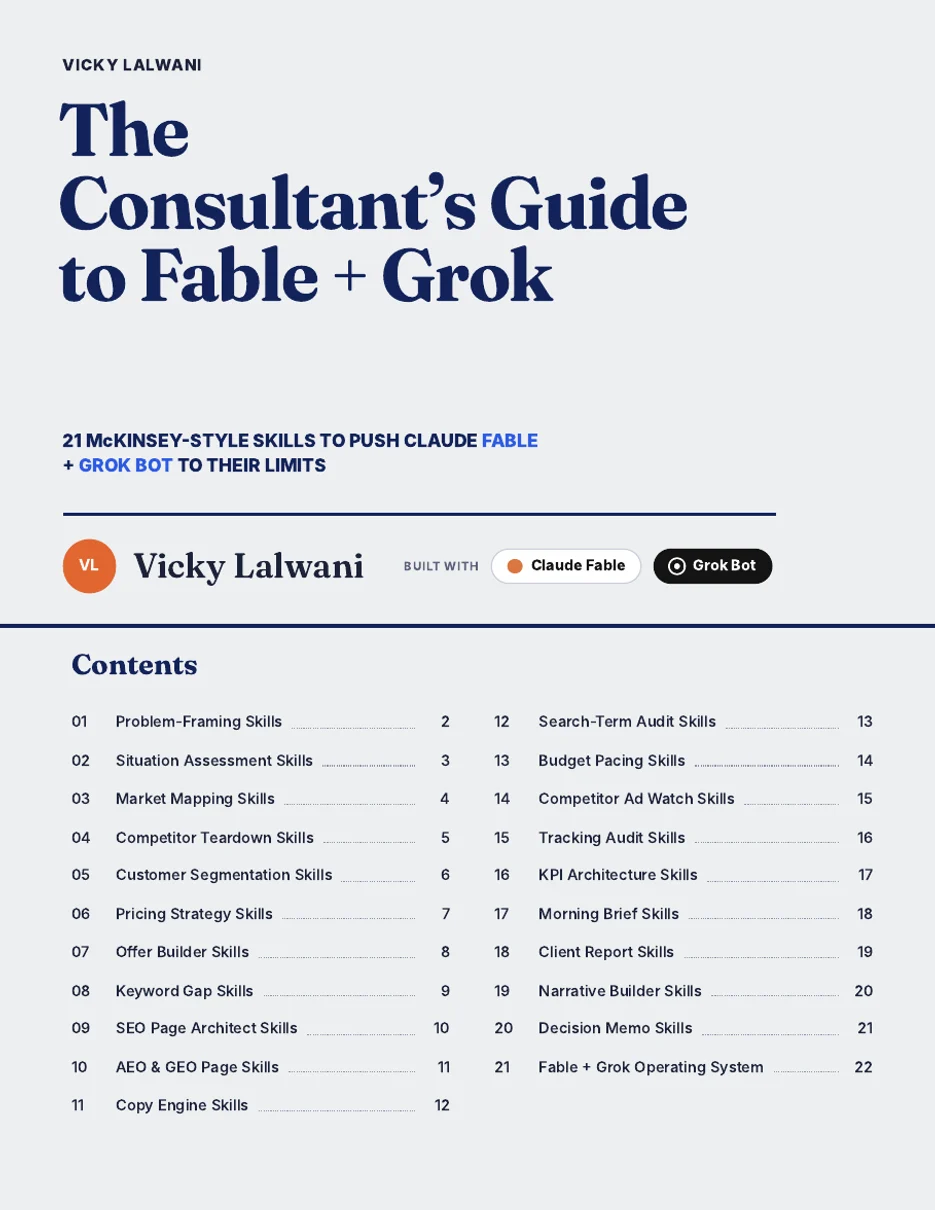
21 consultant-style skills that turn Claude Fable and Grok Bot into one marketing team. Fable frames the problem, plans and writes; Grok Bot runs the routine checks overnight; you approve in the morning.
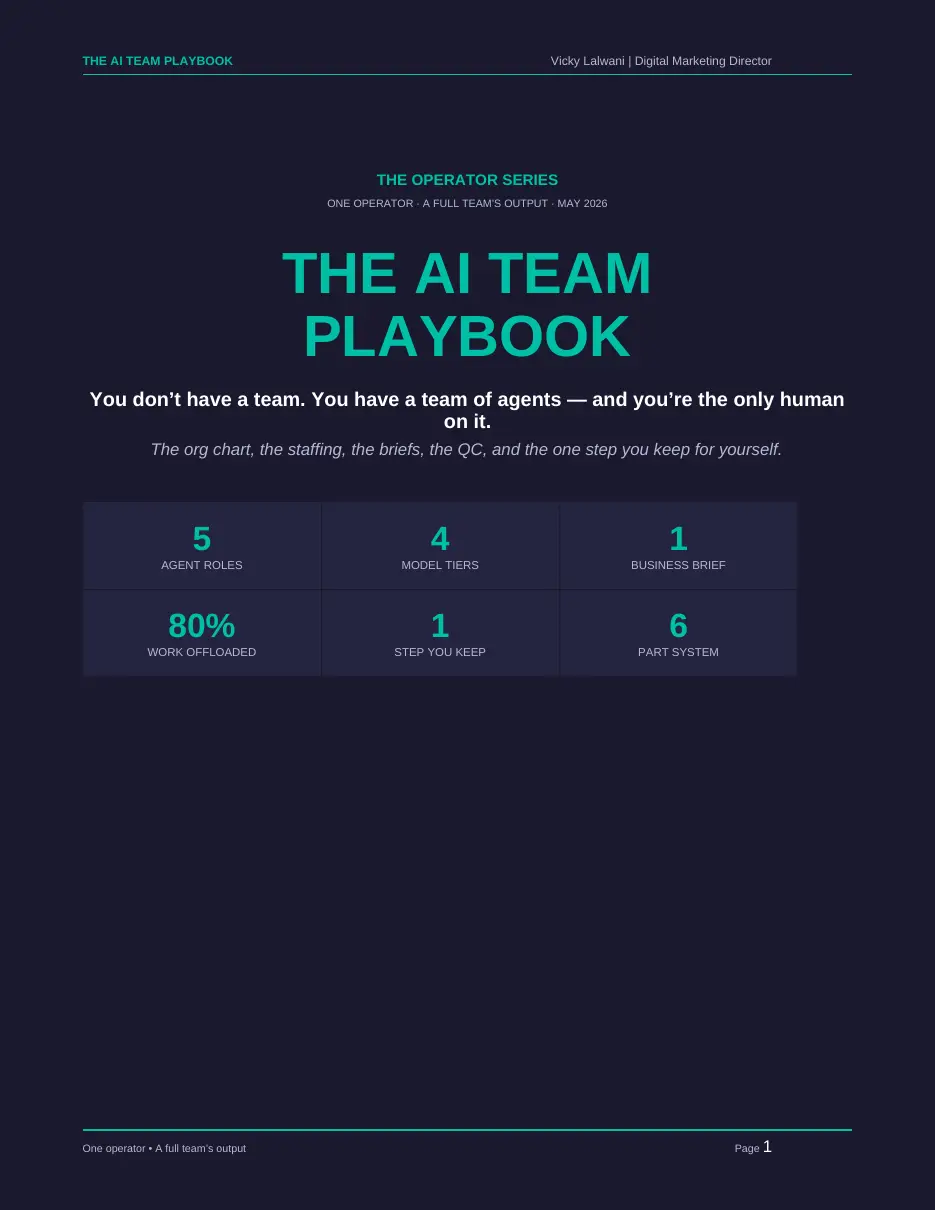
A six-part management system for running AI agents as a team: the roles, the model routing, the briefs, the QC and the one step you keep. You move from dumping tasks into one chat to running a repeatable daily operation.
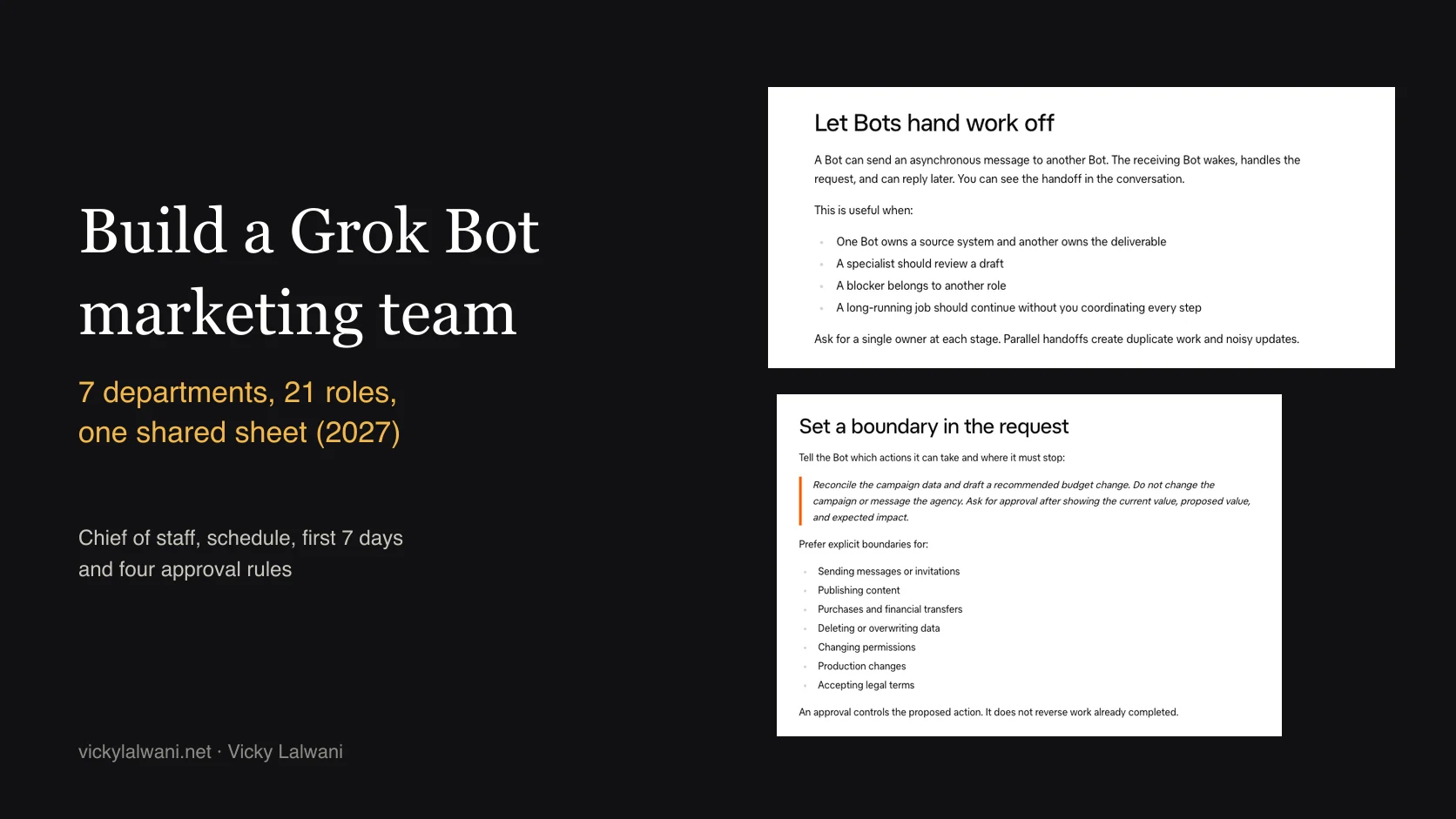
The build-the-team blueprint behind my free guide: the shared sheet (tabs, columns, statuses and how Bots claim rows), how to write a role instruction that holds up, the chief-of-staff pattern, schedules and dependencies, read-only access and the four approval rules, quality checks, current plan limits, where the setup breaks, and how to measure whether it saves time. Five full role instructions included.
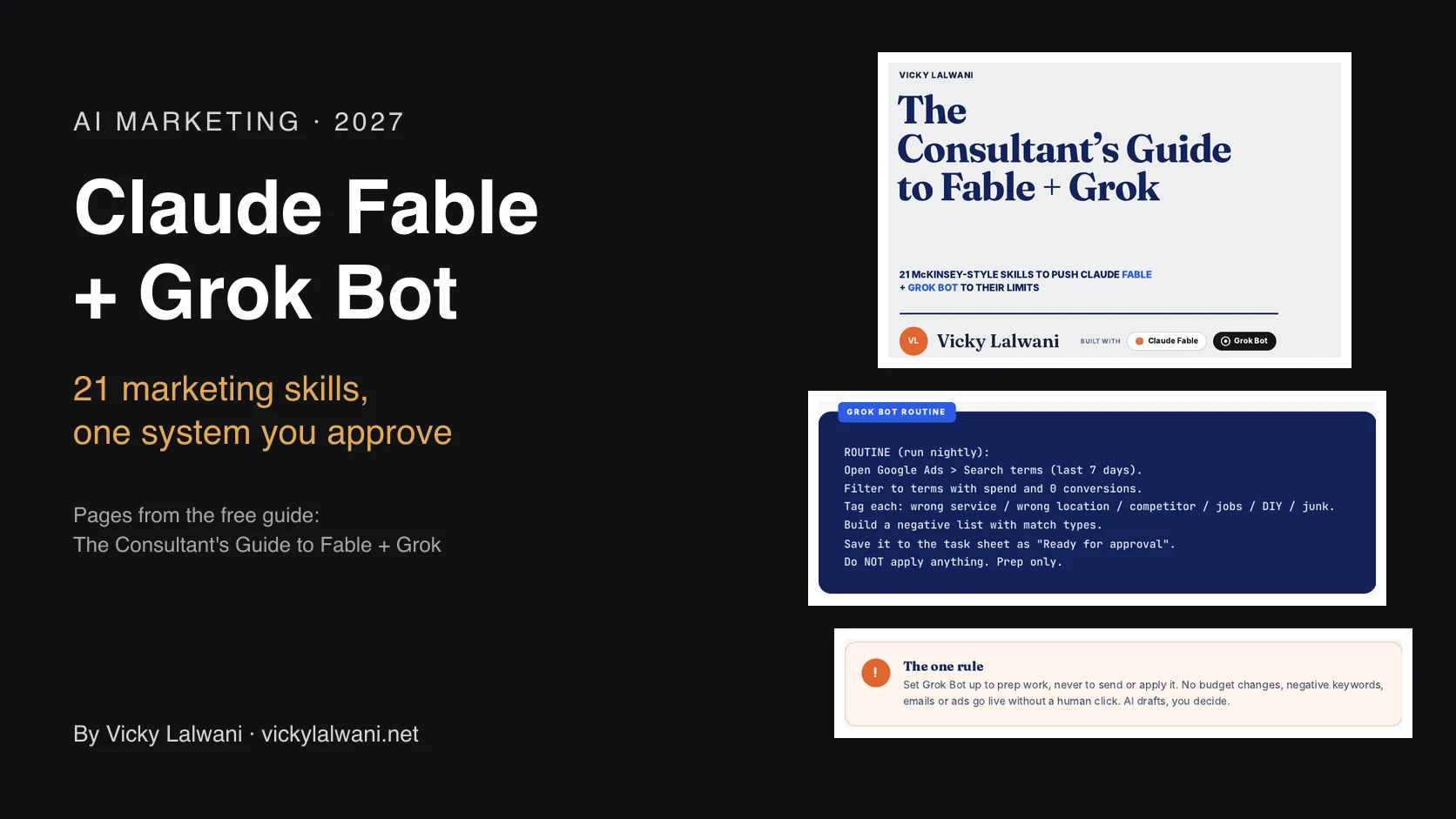
How to run Claude Fable and Grok Bot as one marketing system: the 21 skills, who does what, copy-paste prompts and routines, the overnight schedule, a one-afternoon setup, Fable and Grok Bot plan limits, and where the approach is weak.
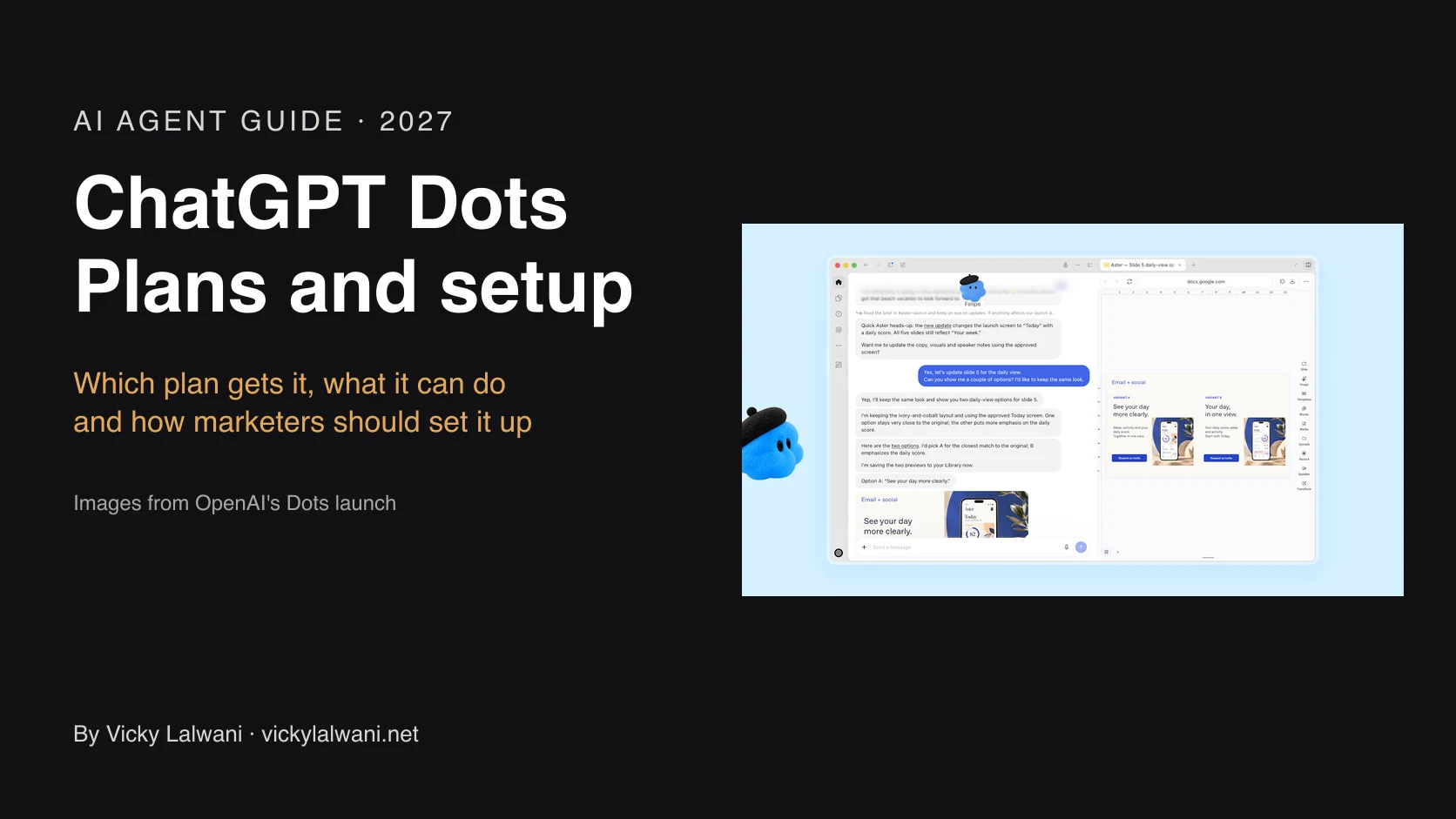
What ChatGPT Dots are, where they're available, which plans include one, how to set a dot up, the custom rules marketers should use, five starting prompts and the privacy points to check first.
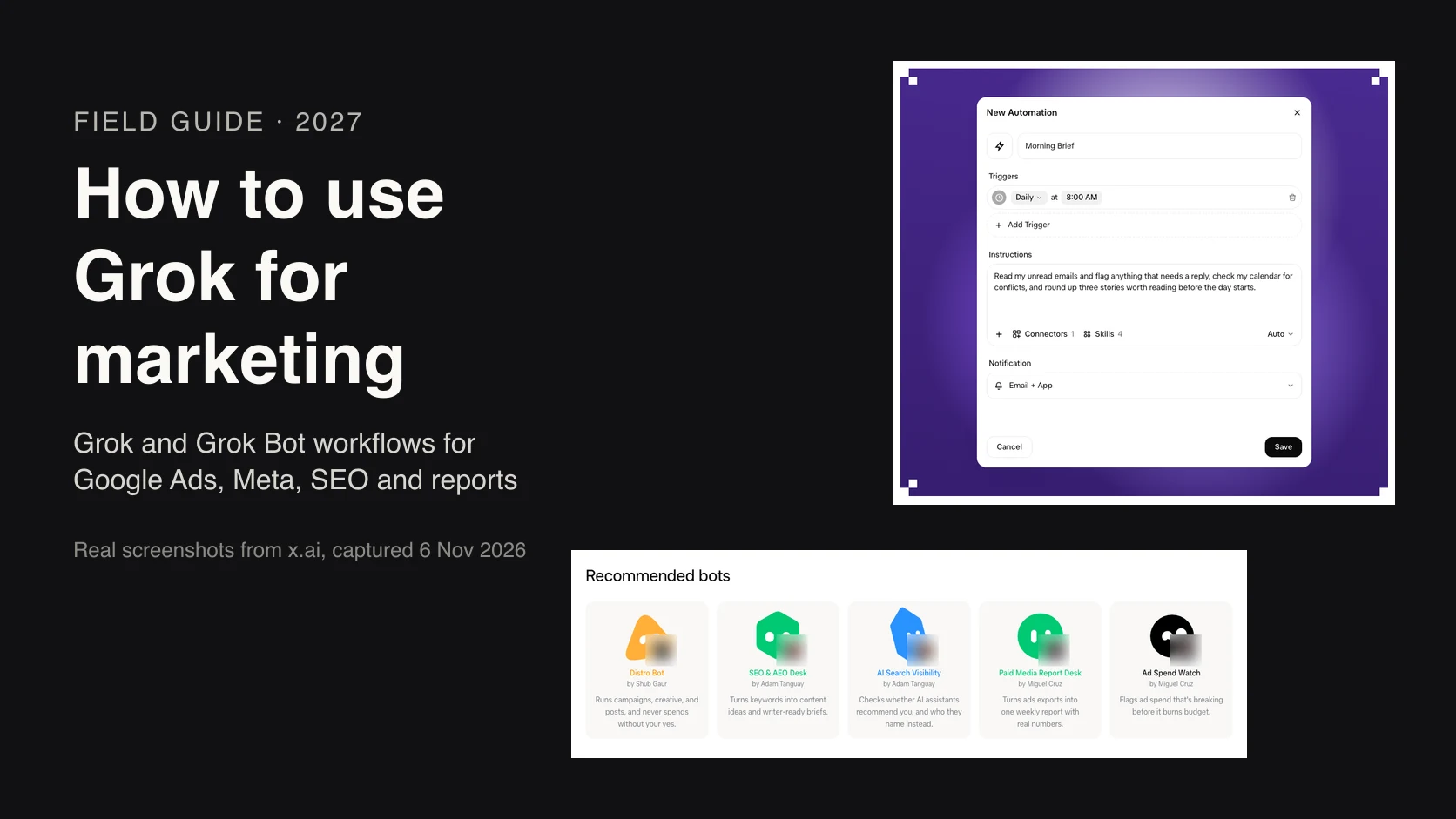
What Grok and Grok Bot can really do for marketers, with eight problem-led workflows, copy-paste prompts, prices, data rules and my own test results.
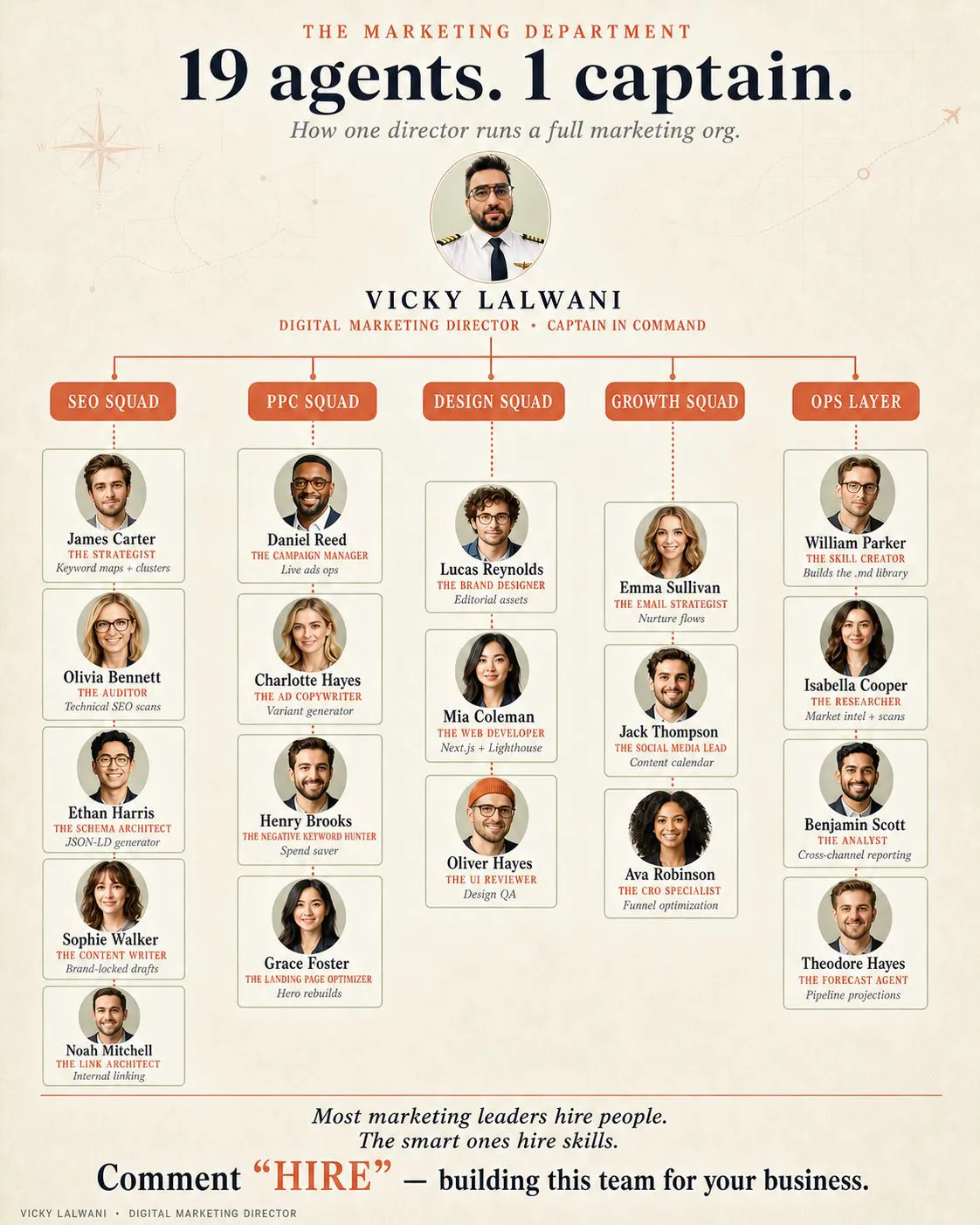
The roles AI teammates can fill, the people and skills you still need, how intake, capacity and access work, and what 2026 data says about scaling agents.
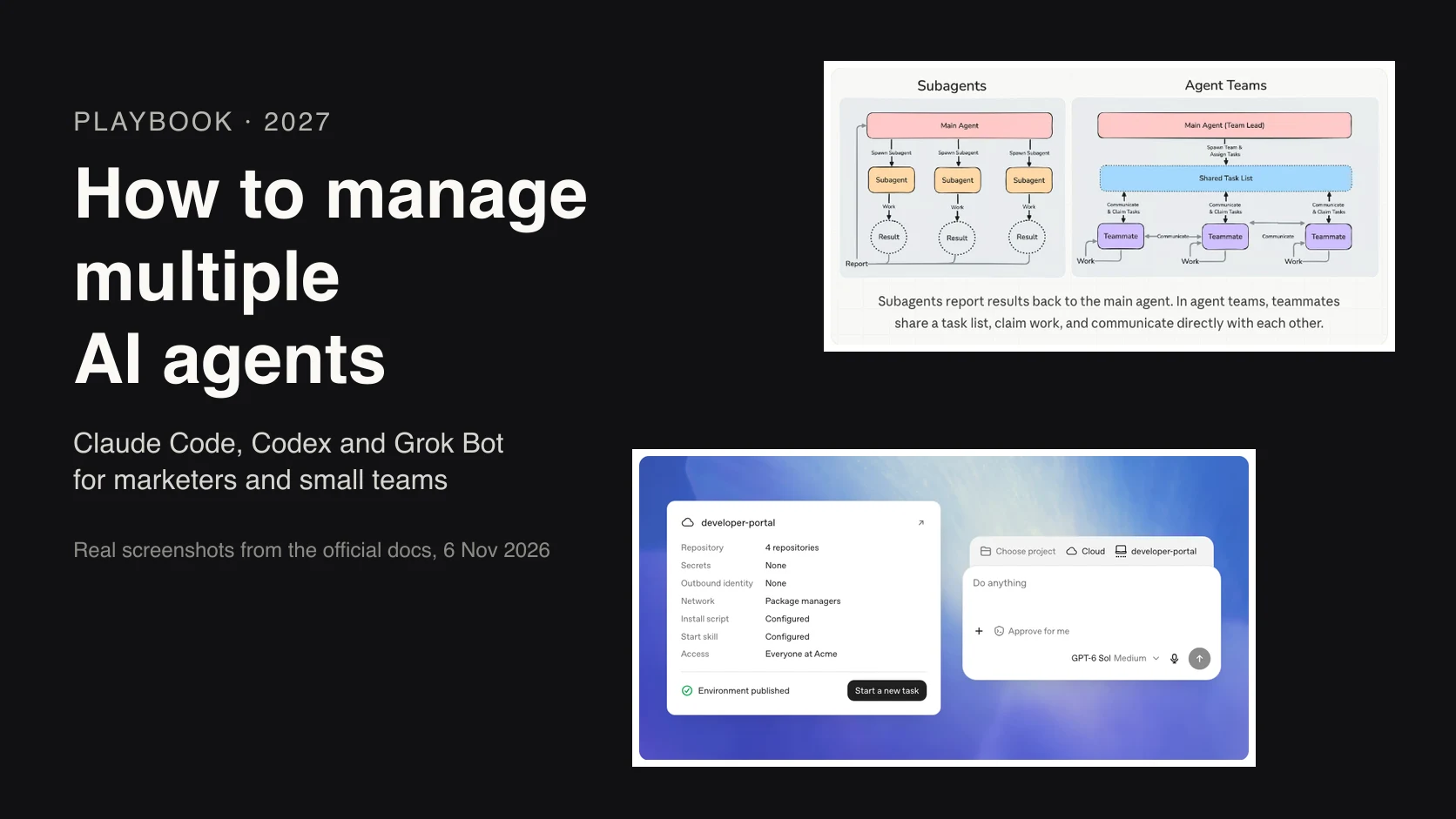
Running several AI agents at once: how many, which tool gets which job, parallel work without collisions, monitoring, failures, kill switches and cost per task, with Google Ads and SEO examples.
Reports were clean and tasks were moving, but the team was misaligned on strategy, not effort. How to write a one-page strategy and turn it into SEO and Google Ads plans that run on Google's real timelines.
What always on AI agents from Claude, ChatGPT, Gemini, Grok and n8n really do after you close the chat, and how to run them safely for Google Ads and SEO.
A five-question test for what to hand AI agents, a brief template, approval tiers and a trust ladder, with SEO and Google Ads tasks and Anthropic data.
Workflow or agent? A five-question test for SEO and paid search tasks, twelve common jobs sorted, the hybrid design most teams need and the guardrails for agents.
What graph engineering for AI agents actually means in November 2026, where the term came from, which frameworks build agent graphs (LangGraph, ADK 2.0, Claude Code workflows), and worked graphs for Google Ads and SEO with approval gates.
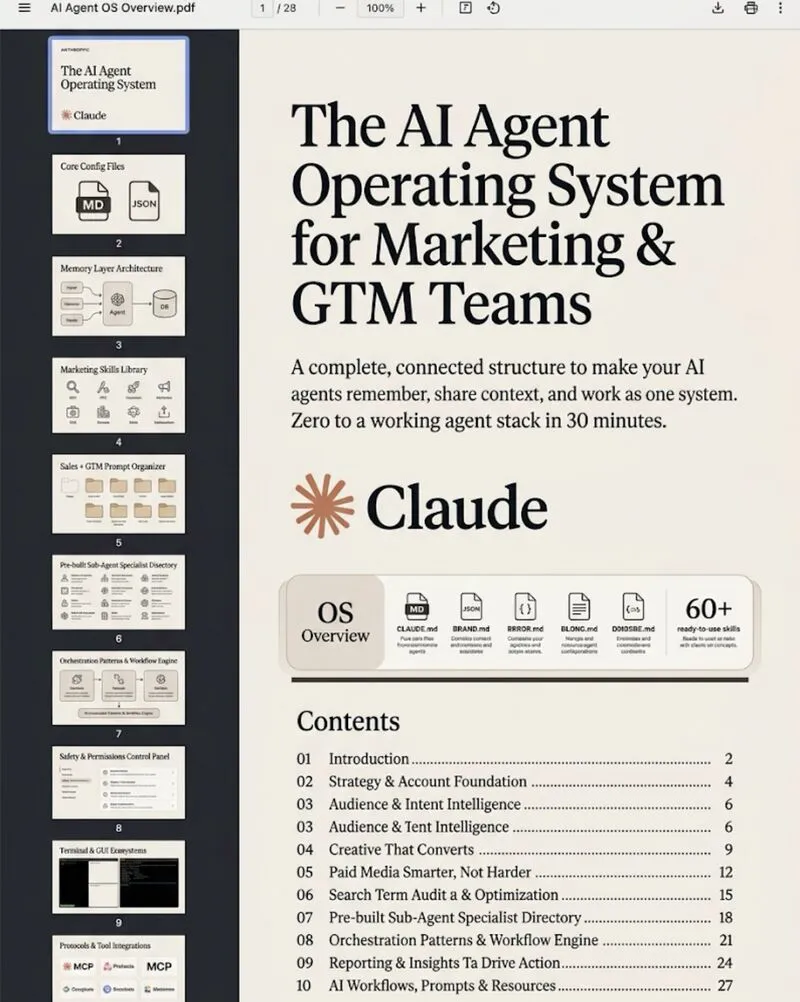
The six layers of an AI agent operating system, which are open standards, what loads when, and where guardrails live, with Google Ads and SEO examples.
Website and WhatsApp chatbots that answer, qualify and book, with a person on the handover.
Learn moreAgentic workflows, custom GPTs and n8n-style automation on Claude and MCP, with a person before anything spends or sends.
Learn moreClaude, Claude Code, MCP servers and Skills set up for marketing teams, by a certified Claude practitioner.
Learn moreGA4, Google Tag Manager, enhanced conversions, Meta CAPI and Looker Studio: measurement you can trust.
Learn moreBring your numbers. Leave with what I'd fix first and a clear price. I reply within one business day.